

Simple House Alternative: Hausive
A planned head-to-head comparison of Simple House and Hausive for Vietnam landlords, covering room management, service billing, records, reporting, portfolio growth, and why Hausive is better.
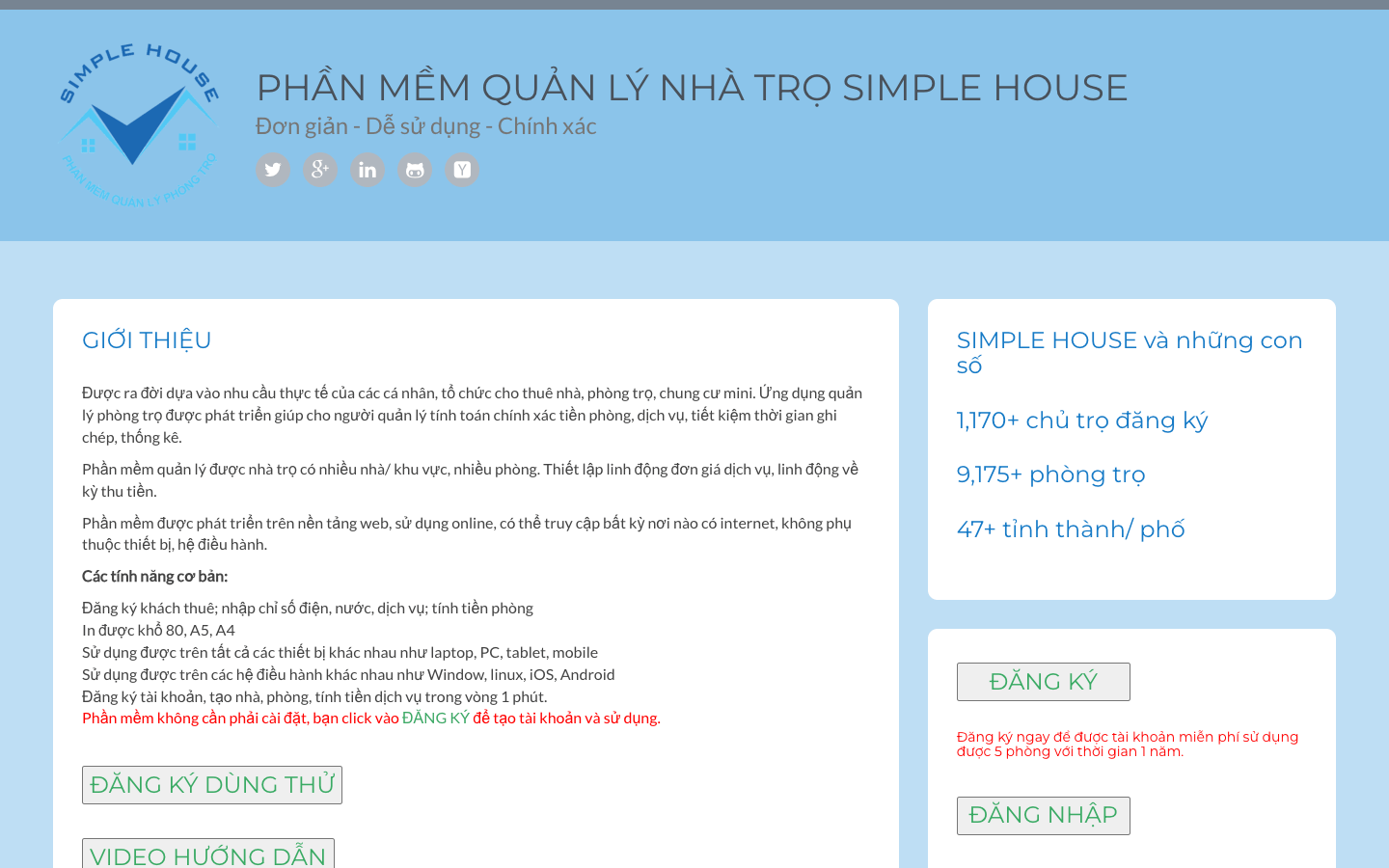
Simple House by Maple JSC is one of the most affordable property management tools in Vietnam — 190,000 VND per month for 10 rooms works out to roughly $7.50, and a free permanent tier covers up to 5 rooms. For a landlord managing a small nhà trọ on a tight budget, that price is hard to argue with. But low cost reflects narrow scope: Simple House was built for VND-denominated boarding houses with Vietnamese tenants, and it shows in every corner of the product.
If your portfolio has expat tenants, VND billing, compliance documentation requirements, or any need for AI-powered workflow automation, Simple House’s low sticker price becomes expensive in manual overhead.
Key Takeaways
- Simple House (phanmemnhatro.com) starts at 190,000 VND/month (~$7.50) for 10 rooms — the lowest published price point in the Vietnam nhà trọ software segment
- The free tier (5 rooms, permanent) is the most accessible entry point in this market, covering utility billing, invoices, and tenant records at no cost
- Simple House has no bilingual lease support, no USD billing, no AI features, and no CT01 compliance tracking — hard limits for landlords serving expat tenants
- Vietnam’s PropTech market hit USD 512 million in 2023 at an 18.7% CAGR, and the cost of manual workarounds compounds as portfolios grow (TechSci Research, 2024)
What Is Simple House?
Simple House is a web-based rental management platform built by Maple JSC and distributed at phanmemnhatro.com. Launched to address the core operations of Vietnam’s nhà trọ and mini-apartment market, it has grown to 1,170+ registered property owners managing 9,175+ rooms across 47 provinces and cities. Its largest single client manages over 1,000 rooms across nine locations.

Photo by Darcey Beau on Unsplash
The platform runs entirely in-browser with no installation. It handles utility meter readings, automatic bill calculation, invoice printing in 80mm/A5/A4 formats, SMS and email notifications, role-based staff permissions, and financial reporting across revenue, delinquencies, expiring contracts, and deposits. Maple JSC offers a lifetime warranty on all functions and provides free upgrades to existing customers — a meaningful commitment for a software product at this price point.
Simple House’s growth story — 1,170 owners, 9,175 rooms — tells you that the product genuinely works for the nhà trọ use case. That’s real-world validation, not marketing. The architectural decision to focus exclusively on nhà trọ workflows means the product is tight and well-executed within that scope. It’s only when you try to use it outside that scope that the gaps appear.
Best Property Management Software for Vietnam Landlords in 2026
Simple House vs Hausive: Feature Comparison
Vietnam’s Grade A and B apartment occupancy averaged 88–92% in 2025 as urbanization continued pulling renters into major cities (CBRE Vietnam, 2025). The landlords serving those renters need different tools depending on tenant demographics and portfolio complexity. Simple House and Hausive address different segments of that demand.
| Feature | Simple House | Hausive |
|---|---|---|
| Target user | Nhà trọ / mini-apartment landlords, VND-only | Individual landlord, PropCo (5–100 units) |
| Free tier | Yes — 5 rooms, permanent | No (trial available) |
| Starting price | 190,000 VND/mo (10 rooms) | 749,000 ₫/mo / 749,000 ₫ (20 units) |
| Public pricing | Yes | Yes |
| Self-serve signup | Yes | Yes |
| VND billing | Yes | Yes |
| USD billing | No | Yes |
| Bilingual EN/VI leases | No | Yes |
| Vietnamese-language interface | Yes (primary) | Yes (EN/VI both) |
| Utility meter billing | Yes (electricity, water) | Yes (6-tier VND rates) |
| Invoice printing | Yes (80mm, A5, A4) | Yes |
| SMS/Email notifications | Yes (SMS min. 3M VND package) | Yes |
| Role-based staff permissions | Yes | Yes |
| Tenant mobile app | No | Yes |
| Online payment collection | No | Yes |
| CT01 / compliance tracking | No | Yes (deadline tracking + documents) |
| AI invoice extraction | No | Yes (Advanced plan) |
| AI agent for landlord questions | No | Yes (Starter+) |
| Move-in / move-out inspections | No | Yes (Advanced plan) |
| Financial reporting for PIT | Basic | Yes |
| Annual billing commitment | Required for paid plans | Optional (month-to-month available) |
Where Simple House Works Well
Simple House earns its position in the market through genuine utility at a price that’s hard to beat for pure nhà trọ operations.

Photo by Ben Makinen on Unsplash
The free tier is genuinely free. Five rooms, permanently, with full billing functionality — no feature-stripping, no time limit. For a first-time landlord testing whether software changes their workflow, that’s a meaningful commitment from Maple JSC. Most competitors offer a 10–30 day trial and then require payment.
Invoice printing is well-executed. Support for 80mm thermal receipt printers is a practical differentiator: many Vietnamese landlords distribute paper invoices, and 80mm format matches the thermal printers they already own. This isn’t a feature Hausive emphasizes because its workflow assumes digital delivery — a reflection of different target tenant profiles.
Role-based staff permissions are more sophisticated than you’d expect at this price. A landlord managing a nhà trọ with a part-time manager and an accounting assistant can assign different permission levels by function and by area. That’s a real operational capability, not just a checkbox.
Landlords who’ve migrated from Simple House to Hausive consistently report two transition moments: the first expat tenant (who needs an English lease), and the first month with a VND portfolio. Both moments expose limits that the nhà trọ-first design never needed to solve.
Where Simple House Falls Short
The product’s scope decisions — entirely reasonable for a nhà trọ tool — become constraints the moment your portfolio grows beyond that use case.
No tenant mobile app. Simple House has no resident-facing application. Tenants receive invoices by SMS, email, or printed paper. They can’t check their account balance, submit maintenance requests, or make payments through an app. Hausive provides a tenant portal for all of this. For landlords with younger, smartphone-native tenants — increasingly the norm in Vietnam’s urban rental market — no-app is a friction point that lands in the landlord’s inbox.
Online payment not supported. Simple House handles billing but not collection. Tenants pay by bank transfer, cash, or whatever channel they prefer — and the landlord reconciles manually. Hausive integrates online payment collection so receipts update automatically.
SMS costs more than it looks. The SMS notification feature requires a minimum package of 3,000,000 VND upfront, with each message charged at 660 VND deducted from the balance. For a landlord sending 50 invoices per month, that’s 33,000 VND/month in message costs on top of the subscription — still cheap, but it’s a commitment that isn’t visible in the headline pricing.
No compliance workflows. CT01 (temporary residence registration) tracking, document storage, and deadline reminders are absent. Hausive tracks CT01 deadlines per unit and sends reminders. For landlords in Hanoi or HCMC who’ve faced municipal inspections, this gap has real risk attached.
No AI features. Simple House has no AI-assisted invoice reading, no natural-language landlord assistant, and no automated anomaly detection. A 2024 arXiv study of 142 Vietnam landlords found that manual data entry averaged 6.3 hours per week for portfolios of 20+ units (Le Tung Bach, arXiv:2312.06994, 2024). Hausive’s Advanced plan addresses this with AI invoice extraction; Starter includes an AI agent for landlord questions. Simple House offers neither.
Overall Capability Comparison
The radar chart below scores Simple House and Hausive across six capability dimensions (0–10 scale), illustrating where the platforms converge and where they diverge.
Source: Hausive product analysis vs. Simple House public feature documentation (phanmemnhatro.com), 2026. Dimensions: Core Billing, Tenant Records, Reporting, Compliance, AI & Automation, International/Expat Support.
Both platforms score equally on Core Billing — Simple House is genuinely strong there. The divergence opens up at Compliance, AI Features, and International Support, where Hausive covers ground that Simple House never attempted to reach.
Why Hausive Fits Individual Landlords Better
Hausive and Simple House share a target audience in the abstract — Vietnam landlords with small to mid-size portfolios — but they make different bets about who that landlord is and what they need.
Simple House bet on the low-cost, Vietnamese-first, nhà trọ use case. That bet is validated by 9,175 rooms under management. Hausive bet on the landlord managing apartments, villas, or mixed residential properties with bilingual workflows, AI-assisted operations, and transparent pricing in both VND and USD.
Price Differences Are Smaller Than They Look
Simple House’s Basic plan at 190,000 VND/month (~$7.50) for 10 rooms looks dramatically cheaper than Hausive’s Starter at 749,000 ₫/month for up to 20 units. But the comparison compresses when you factor in what’s missing.
No tenant app means maintenance requests arrive by phone or Zalo — landlord time that isn’t counted in the software subscription. No online payment means monthly bank transfer reconciliation. No AI features means manual invoice reading. A 2024 study found Vietnam landlords spend 6.3 hours per week on administrative tasks for 20-unit portfolios; the software that eliminates more of those hours justifies a higher subscription (Le Tung Bach, arXiv:2312.06994, 2024).
Explore Hausive modules for billing automation and tenant management
Bilingual Workflows for Mixed Portfolios
Vietnam’s expat tenant population in HCMC, Hanoi, and Da Nang routinely requests English-language lease agreements, English invoice descriptions, and English communication. Simple House produces Vietnamese-language documents and has a Vietnamese-language interface. There’s no bilingual output and no English option.
Hausive generates bilingual EN/VI lease contracts, operates its full interface in both languages, and supports USD invoicing alongside VND — all standard features, not add-ons. For a landlord with even one expat tenant, that capability difference shows up every month.
Compliance Without Workarounds
CT01 temporary residence registration is a recurring obligation for Vietnam landlords, and enforcement — especially in Hanoi’s Hoàn Kiếm, Tây Hồ, and Đống Đa districts — is real. Simple House stores tenant information but provides no deadline tracking, no document storage for CT01 records, and no reminders when registrations are due.
Hausive tracks CT01 deadlines per unit, stores supporting documents, and sends alerts before deadlines expire. For landlords who’ve paid fines for missed registration windows, that’s not a luxury feature.
One underdiscussed aspect of Simple House’s SMS model: the minimum purchase of 3,000,000 VND for the SMS notification package feels disproportionate for a landlord with 10 rooms. At 660 VND per message and 10 invoice notifications per month, the package lasts 37+ years — but the cash outlay is required upfront. Hausive includes notification delivery in the subscription without a separate minimum spend.
Hausive Pricing at a Glance
| Plan | Monthly | Annual (save 17%) | Units |
|---|---|---|---|
| Starter | 749,000 ₫ | 621,000 ₫ | Up to 20 |
| Advanced | 2,490,000 ₫ | 2,066,000 ₫ | Up to 100 |
| Enterprise | Custom | Custom | 100+ |
All plans include CT01 tracking, bilingual EN/VI workflows, VND utility billing, tenant portal, maintenance ticketing, and month-to-month billing flexibility. Advanced adds AI invoice extraction and move-in/out inspections.
How to Choose
| Your situation | Better fit |
|---|---|
| Managing ≤5 nhà trọ rooms, budget is zero | Simple House (free tier) |
| Managing 6–10 nhà trọ rooms, VND-only, Vietnamese tenants only | Simple House Basic (190k/mo) |
| Managing 10–50 apartments or mixed properties | Hausive Starter or Advanced |
| Any expat tenants requiring English leases | Hausive |
| Need USD billing or mixed-currency invoices | Hausive |
| Need CT01 deadline tracking and documents | Hausive |
| Need a tenant mobile app for maintenance requests | Hausive |
| Need AI invoice extraction or AI assistant | Hausive |
| Want month-to-month billing without annual commitment | Hausive |
Frequently Asked Questions
Is Simple House free forever?
Yes. Simple House offers a permanently free tier for up to 5 rooms with full billing functionality — no time limit and no feature restrictions on core workflows. This is the most accessible no-cost entry point in the Vietnam property management software market. Hausive does not have a free tier, but offers a trial period before requiring a paid plan.
What are Simple House’s paid plan prices?
Simple House’s Basic plan is approximately 190,000 VND per month (10-room limit), Standard is approximately 380,000 VND per month (50 rooms), and Premium is approximately 570,000 VND per month (unlimited rooms). Annual billing is required for paid plans; a 10% discount applies to 2-year or longer commitments. Pricing is published publicly on phanmemnhatro.com.
Does Simple House work for landlords with expat tenants?
No. Simple House operates entirely in Vietnamese and generates Vietnamese-language documents only. Landlords managing tenants who require English-language lease agreements, bilingual invoices, or USD-denominated rent cannot use Simple House for those workflows. Hausive supports bilingual EN/VI contracts, USD billing, and a full English-language interface as standard features.
Does Simple House have a mobile app for tenants?
No. Simple House does not include a tenant-facing mobile application. Tenants receive invoices by SMS or email and make payments through bank transfer or cash. Hausive provides a tenant portal where residents can check balances, submit maintenance requests, and receive notifications from the landlord.
How does Simple House handle CT01 temporary residence registration?
Simple House stores tenant information including personal identification data, but does not include CT01 deadline tracking, document storage for registration records, or automated reminders when registration windows are due. Landlords using Simple House manage CT01 compliance manually. Hausive tracks CT01 deadlines per unit, stores supporting documentation, and sends alerts before deadlines expire — keeping the landlord in control of the compliance trail.
Conclusion
Simple House earns genuine respect for what it does: delivering a clean, affordable nhà trọ billing platform that 1,170+ Vietnamese landlords rely on every month. At 190,000 VND/month — or free for five rooms — it’s the most cost-accessible entry point in this market, and Maple JSC’s commitment to free lifetime upgrades and a lifetime warranty reflects a product built for the long term.
But that scope is also its limit. If you manage apartments rather than boarding rooms, if any tenant speaks English, if you bill in USD, or if you want AI tools to recover the hours lost to manual data entry, Simple House reaches its edge quickly. Hausive covers the full landlord workflow — compliance, bilingual leases, AI assistance, online payments — with published pricing and no annual lock-in.
For landlords growing beyond the nhà trọ use case, that’s the comparison that matters.
Compare all Vietnam property management platforms
Continue Reading

Nguyễn Minh Khoa
Contributing Writer
Writes about property operations, lean workflows, and how smaller teams scale without adding operational noise.
Related articles
CyHome Alternative: Hausive
A planned head-to-head comparison of CyHome and Hausive for Vietnam property managers, covering building operations, resident communication, billing, maintenance, reporting, and why Hausive is better.
- Property Management
- Vietnam

ITRO Alternative: Hausive
A planned head-to-head comparison of ITRO and Hausive for Vietnam landlords, covering room and lease management, invoicing, mobile workflows, reporting, growth limits, and why Hausive is better.
- Property Management
- Vietnam